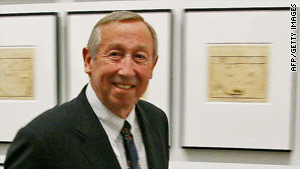
Statler Family Obituaries
Disney, Roy Edward
LOS ANGELES — Roy E. Disney, the son and nephew of The Walt Disney Co. founders who twice led shareholder revolts that shook up the family business, died Wednesday. He was 79.
The Walt Disney Co. announced that Disney died in Newport Beach, Calif., after a bout with stomach cancer.
Although he generally stayed out of the spotlight, Roy Disney didn't hesitate to lead a successful campaign in 1984 to oust Walt Disney's son-in-law after concluding he was leading the company in the wrong direction.
Nearly 20 years later, he launched another successful shareholders revolt, this time against Michael Eisner, the man he'd helped bring in after the previous ouster.
Disney, born in 1930, had practically grown up with the company. His uncle Walt Disney and his father, Roy O. Disney, had co-founded the Disney Brothers Cartoon Studio seven years before, later renaming it The Walt Disney Co.
Two years before he was born, the company gave birth to its iconic cartoon character, Mickey Mouse. While Walt was the company's creative genius, his brother was the one in charge of the company's finances.
Starting in the 1950s, the younger Roy Disney worked for years in the family business as an editor, screenwriter and producer. Two short films he worked on were nominated for Academy Awards: the 1959 "Mysteries of the Deep," which he wrote, was nominated as best live action short, and the 2003 film "Destino," which he co-produced, was nominated as best animated short.
Despite his heritage, Roy Disney never got the chance to lead the company as his father and uncle had. But as an investor who grew his Disney stock into a billion-dollar fortune, he ultimately had a huge impact on the company's destiny.
In 1984, dissatisfied with the leadership Walt's son-in-law Ron Miller was providing, Disney resigned from the company's board of directors and sought investors to back a bid to install new management. (Miller was the husband of Diane Disney Miller, Roy's cousin.)
His efforts resulted in the hiring of Eisner and Frank Wells, who led the company as a team until Wells died in 1994.
During that time, Disney rejoined the board and rose to become the company's vice chairman and chairman of its animation division, where he helped oversee the making of such hit films as 1994's "The Lion King."
He also became a savvy investor over the years, forming Shamrock Holdings with his friend and fellow Disney board member Stanley Gold in 1978. The fund grew to become a major investor in California real estate, the state of Israel and other entertainment and media companies.
In 2007, Forbes magazine ranked him as the 754th richest person in the world and estimated his fortune at $1.3 billion. He was not on the list in subsequent years.
In his spare time he bought a castle in Ireland and indulged his passion for yacht racing, setting several speed records. For years he was a fixture at the Transpacific Yacht Race between California and Hawaii.
After years of dissatisfaction with Eisner's leadership and the company's lagging stock price, Disney and Gold resigned their board seats in 2003 and launched a shareholder revolt.
In his resignation letter, Disney called for Eisner's ouster, complaining that on his watch the company's standards had declined, particularly at theme parks like California's Disneyland and Florida's Walt Disney World.
"The Walt Disney Company deserves fresh, energetic leadership at this challenging time in its history just as it did in 1984 when I headed a restructuring which resulted in your recruitment to the company," Disney wrote to Eisner.
Initially rebuffed, Disney rallied small investors and enthusiasts who responded to his folksy complaints about peeling paint at the theme parks and his anger at being told he would have to leave the board because he was too old.
"One of the reasons for my leaving, other than the fact that they fired me, was that I saw that quality slipping away from us," Disney told a 2004 meeting of memorabilia collectors.
Slowly, Disney built support for his cause, and at the company's annual shareholders meeting in 2004 he received a standing ovation.
Shareholders eventually delivered an unprecedented rebuke to Eisner, withholding 45 percent of votes cast for his re-election to the board.
The chief executive was later stripped of his role as board chairman and announced his retirement in 2005, a year before his contract was up.
Disney initially opposed Eisner's successor, Robert Iger, but they reconciled and in 2005 Iger named Disney a board member emeritus and welcomed him back to company events.
Born in Los Angeles on Jan. 10, 1930, Roy Edward Disney was Roy and Edna Disney's only child. As an adult, he often wore a mustache, which gave him a striking resemblance to his legendary uncle.
After graduating from Pomona College in 1951, he briefly worked at NBC as an assistant editor on the "Dragnet" TV series.
After joining Disney, he worked on a series of live action short features, including "The Living Desert" and "The Vanishing Prairie."
Disney was also an active philanthropist, supporting the California Institute of the Arts in Valencia, a school founded by his father and uncle.
In 1999, he matched a gift from The Walt Disney Co. to establish an experimental theater space as part of the Walt Disney Concert Hall in Los Angeles. The theater was named the Roy and Edna Disney-CalArts Theater or Redcat.
In 2005, he pledged $10 million to establish the Roy and Patricia Disney Cancer Center at Providence St. Joseph Medical Center in Burbank.
News Story found at the Fox News website posted on Wednesday, December 16, 2009
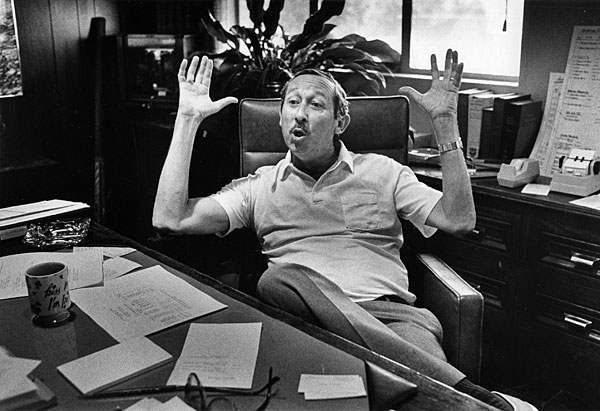 Roy Edward Disney, seen in his Burbank office in 1985, was the billionaire nephew of entertainment icon Walt Disney. Roy E. Disney so closely resembled his uncle's physical appearance that when he made outings to Disney theme parks or was out promoting the company's animated films, people in public would ask him if he was Walt Disney's brother. (Los Angeles Times) |
By James Bates and Dawn C. Chmielewski
December 16, 2009 | 12:27 p.m.
Roy Edward Disney, the nephew of Walt Disney whose commitment to his uncle's creative
spirit prompted him to mount revolts that led to the unseating of two of the company's
chief executives and a revival of the studio's legendary animation unit, died today. He
was 79.
Disney, who had been battling stomach cancer, died at Hoag Memorial Hospital Presbyterian
in Newport Beach, according to Clifford A. Miller, a spokesman for Disney's company
Shamrock Holdings.
Disney toiled for years in the shadow of his famous uncle and his father, Roy O. Disney,
who behind the scenes ran the business side of the Walt Disney Co. for his brother. But
the quiet man in the cardigan sweater would emerge as a forceful protector of family
traditions.
"People always underestimated Roy," said Peter Schneider, the former president
of Walt Disney Feature Animation. "You underestimate Roy at your peril, as many
people have learned."
Disney devoted the first 20 years of his career to making nature films, among them
"Pancho, A Dog of the Plains," "The Owl That Didn't Give A Hoot" and
an Oscar-nominated short subject "Mysteries of the Deep." After the death of
Walt in 1966 and Roy's father in 1971, the younger Disney was spurned in his efforts to
take a larger role with the company. He finally quit in 1977, but remained on its board as
a director, where he was largely a figurehead.
Adrift, Disney hooked up with lawyer Stanley Gold and became a successful financier,
investing successfully in a wide variety of businesses that included broadcasting,
soybeans and Israeli industrial concerns through Shamrock Holdings, a company named for
one Disney's racing sloops.
During the 1980s, Gold, Disney and Shamrock became one of the better-known corporate
raiders, making unsuccessful hostile takeover bids for companies such as the Polaroid
Corp. camera maker and the Wherehouse Entertainment chain of music stores. Its takeover of
Central Soya, a soybean processor in Fort Wayne, Ind., would yield a sizable $170-million
profit for Shamrock and its partners with its subsequent sale to an Italian agricultural
concern. Through investments, Gold sought to free Disney of his financial dependence on
the Disney company stock he inherited. Most were successful, although Shamrock stumbled on
some, particularly a money-losing investment in sneaker maker L.A. Gear.
By 1984, Disney had grown increasingly frustrated with the Walt Disney Co., which he
likened to a real estate company that happened to be in the movie business. The company
had let its feature animation film business, once the cornerstone of the company,
deteriorate. The company, Disney would later say, had lost its creative drive.
"I said to him, 'Roy, I think you've reached a point where you need to get all the
way in or all the way out,' " Gold said. "He said, 'What does that mean?' I
said, 'You either need to sell your shares in Disney and go independent, or you need to
put up a fight and get rid of the managers and find real managers for this business.'
"
With his financial independence established from his investments, Disney pondered with
Gold and a handful of other advisors what, if anything, they could do. Finally, a decision
was made to try to unseat the company's management, made sticky by the fact that Walt's
son-in-law, Ron Miller, was chief executive. Disney abruptly quit the company board in
1984, sending a signal to investors and Wall Street that something was amiss. The turmoil
Disney ignited eventually swept the old management group from the corporate suites.
In the end, Disney, with an alliance formed with the billionaire Bass family of Texas,
returned to the board and forced out the studio management, paving the way for the hiring
of a new team led by Michael Eisner, Frank Wells and Jeffrey Katzenberg.
Upon taking over as chief executive, Eisner asked Disney what he wanted to do. Disney
responded that he wanted to revive the company's sagging animation division, where morale
was rock-bottom as the company was releasing one of its worst-reviewed films, "The
Black Cauldron." Wells and Katzenberg both opposed the idea, said Gold, but Eisner
granted Disney his wish -- in a gesture of gratitude.
Disney persuaded the new regime to invest about $10 million in computer animation
equipment, a seemingly minor decision that proved to be a turning point in the company's
fortunes. Within a few years, the company turned out a remarkable string of animated hits,
including "The Little Mermaid," "Beauty and the Beast,"
"Aladdin" and "The Lion King." The films won critical acclaim and
proved wildly lucrative as well, with money pouring into the company not only from the box
office, but from the sales of T-shirts, toys and home videos.
"It was Roy who was the protector. It was Roy who was the godfather, the champion and
believer in it," said Schneider, who had lunch with Disney every Tuesday for 16 years
in the executive dining room, even when animation had been exiled to warehouses in
Glendale. "Animation doesn't work without someone who believed, and Roy
believed."
Disney's pet project, a new version of the 1940 Walt Disney classic "Fantasia,"
was released in 2000, initially in big-screen IMAX form. Called "Fantasia/2000,"
the film, like the original, blended animation inspired largely by classical music.
Included were segments set to Gershwin's "Rhapsody in Blue" and Ottorino
Respighi's "Pines of Rome." Disney also included "The Sorcerer's
Apprentice," the cornerstone of Walt Disney's original, in the new version.
At the same time, relations between Disney and Eisner had grown increasingly strained,
with the two men communicating mostly by phone and through e-mail. Tensions had been
building since the 1994 death of the company's president and chief operating officer,
Frank Wells, which left Eisner solely in control of the company. Disney complained to
confidants that he was being marginalized by the executive he had helped install as chief
executive.
By November 2003, Disney learned that the board's four-member nominating committee was
planning to leave his name off the slate of directors scheduled to be elected at the
company's next annual meeting. The longtime animation chief discovered he had been shut
out of a Thanksgiving week screening of ideas for new animated films. The company had been
in a prolonged financial slump, with its earnings flat and its stock performance anemic,
but the snub was the last straw. Disney and his business partner, Gold, abruptly quit the
board of directors in December 2003 and called for Eisner's resignation.
In a stinging rebuke, Disney said that Eisner's leadership had led to the perception of
the company as "rapacious, soul-less and always looking for the 'quick buck' rather
than long-term value." Although the company's problems were well-known, Disney's
public statement exposed the severity of his personal and professional rift with Eisner. A
month later, Disney called on shareholders to cast a vote of no confidence in the top
executive. Their efforts rallied a stunning 45% no-confidence vote for Eisner at the
company's 2004 annual meeting in Philadelphia, prompting Disney directors to remove Eisner
as board chairman. Five months later, Eisner said he would retire when his contract
expired in September 2006.
Disney did not relish the fight. In an interview with Fortune magazine, he described how
he summoned his four children to a family meeting where they sat together, holding hands,
and agreed he should challenge Eisner.
"His identity is more wrapped up in this company than you can imagine," daughter
Abigail E. Disney told the magazine in 2004.
Disney and Gold continued their fight with the Disney board with a May 2005 lawsuit that
challenged as "a sham" the search process that resulted in the appointment of
Eisner's hand-picked successor as the company's new chief executive, Robert A. Iger. The
new chief executive quickly made peace with Disney, offered him an office at the company's
Burbank studios, a consultancy and the title "director emeritus." Disney and
Gold withdrew their lawsuit challenging Iger's selection.
Born Jan. 10, 1930, in Los Angeles, Disney was the only child of Roy O. and Edna Disney.
Growing up around the studio, Disney was exposed to both the joys of the Walt Disney aura
as well as its darker side. In a 1999 Times interview, Disney recalled how his uncle came
to see him when he had the chicken pox as a boy, enthralling him with a story he wanted to
make into a film about a wooden puppet named "Pinocchio."
"He scared me to death with the stuff about the whale and everything else,"
Disney recalled. "I remember it very, very sharply and very clearly. But when the
movie came out, it was a big letdown for me. It was nowhere near as good as Walt's
version."
Yet his uncle and father fought bitterly at times, and for a while weren't on speaking
terms, communicating only through memos. In the 1999 interview, Disney recalled listening
to the sounds of his father pulling in the driveway at night, trying to pick up on the
subtle signs of whether it had been a good or a bad day with Walt. When the car door
slammed, "you knew it was time to go do your homework," he recalled.
Eventually, Walt wrote his brother a touching letter to make up. He also gave him a peace
pipe, which Roy E. displayed in his office after his father died.
After graduating from Pomona College, Disney initially spurned working for the studio,
taking a job as a film editor on the television police series "Dragnet." When he
was laid off from that job, his father arranged a job at the company. In 1955, he married
Patty Daily, sister of boyhood friend Peter Daily. The two had two sons and two daughters.
The couple divorced in 2007, after 52 years of marriage.
In addition to daughter Abigail, Disney is survived by his wife, Leslie DeMeuse Disney;
another daughter, Susan M. Disney Lord; his sons, Roy P. Disney and Timothy J. Disney; and
16 grandchildren.
Despite wealth estimated at $600 million, Disney remained shy and outwardly unpretentious,
according to people who knew him. His main indulgences were a castle in Ireland, a jet,
sports cars and financing a passion for sailboat racing. In 1999, Disney fulfilled a
lifelong dream when he and the 12-member crew of his 74-foot Pyewacket sloop -- named for
the witch's cat in the 1958 film "Bell, Book & Candle" -- won the biannual,
2,225-mile Transpacific Yacht Race from Los Angeles to Honolulu, setting a course record.
A heavy smoker of unfiltered Lucky Strikes for much of his life, Disney quit the habit in
his mid-60s after his wife was ordered by doctors to quit. Over the years he gave
relatively few interviews, and only later in life began to feel comfortable making the
kind of public appearances required of him for the company.
As a vice chairman of the studio, Disney would frequently appear at theme parks or help
promote the company's animated films. With his oval face, sloping nose, protruding ears
and mustache, Disney resembled his uncle to the point where people in public would
frequently approach him asking if he was Walt's brother.
Disney's shyness belied a toughness that could surface when needed. He frequently wrote
pointed memos about such things as animation projects, never hesitating to spell out what
parts of a film he didn't like. And he butted heads with former Disney Studios Chief
Jeffrey Katzenberg, who Disney felt took too much credit for the studio's animated hits.
Two of Disney's pet projects in later years included efforts to save the peregrine falcon,
which was inspired by a nature film he made, and the California Institute of the Arts in
Valencia, where he helped carry out the dream of Walt and his father to build and sustain
a top arts college in Southern California.
dawn.chmielewski@latimes.com
Bates, who covered the Walt Disney Co. and wrote much of this obituary while a member of
the Times staff, left the paper in 2007.
News Story found at the Los Angeles Times newspaper posted on Wednesday, December 16, 2009
Roy Edward Disney, the nephew of Walt Disney whose commitment to his uncle's creative
spirit prompted him to mount revolts that led to the unseating of two of the company's
chief executives and a revival of the studio's legendary animation unit, died Wednesday.
He was 79.
Disney, who had been battling stomach cancer, died at Hoag Memorial Hospital Presbyterian
in Newport Beach, according to Clifford A. Miller, a spokesman for Disney's company
Shamrock Holdings.
Disney toiled for years in the shadow of his famous uncle and his father, Disney Studios
co-founder Roy O. Disney, who ran the business side of the company for his brother. But
the quiet scion would emerge as a forceful protector of Disney traditions when he believed
that the company that bore the family name was headed in the wrong direction.
"People always underestimated Roy," Peter Schneider, the former president of
Walt Disney Feature Animation, said recently. "You underestimate Roy at your peril,
as many people have learned."
As chairman of Disney animation, Disney helped guide the studio to a new golden age of
animation with an unprecedented string of artistic and box-office successes that included
"The Little Mermaid," "Beauty and the Beast," "Aladdin" and
"The Lion King." He was executive producer of "Fantasia/2000," the
sequel to the 1940 Disney classic, and the 2004 Oscar-nominated "Destino," based
on a 1945 collaboration between Walt Disney and Spanish painter Salvador Dali.
"I really credit Roy Disney completely with the renaissance of Disney animation,
beginning with 'Little Mermaid' and all the way through that great amazing series of
classic Disney films," said John Lasseter, chief creative officer for Walt Disney and
Pixar Animation Studios.
Nature filmmaker
Disney devoted the first 20 years of his career to working on nature films, including the
Academy Award-winning True-Life Adventure features "The Living Desert" and
"The Vanishing Prairie." His 1959 short subject "Mysteries of the
Deep" received an Oscar nomination. After the death of Walt in 1966 and Roy's father
in 1971, the younger Disney was spurned in his efforts to take a larger role with the
company. He finally quit in 1977, but remained on its board as a director, where he was
largely a figurehead.
Adrift, Disney hooked up with lawyer Stanley Gold and became a successful financier,
investing in a variety of businesses that included broadcasting, soybeans and Israeli
industrial concerns through Shamrock Holdings, a company named for one of Disney's racing
sloops. He served as chairman of the company, which has approximately $2 billion under
management.
During the 1980s, Gold, Disney and Shamrock became one of the better-known corporate
raiders, making unsuccessful hostile takeover bids for companies such as Polaroid Corp.
and the Wherehouse Entertainment chain of music stores. Its takeover of Central Soya, a
soybean processor in Fort Wayne, Ind., would yield a sizable $170-million profit for
Shamrock and its partners with its subsequent sale to an Italian agricultural concern.
Through investments, Gold sought to free Disney of his financial dependence on the Disney
company stock he inherited. Most were successful, although Shamrock stumbled on some,
particularly a money-losing investment in sneaker maker L.A. Gear.
By 1984, Disney had grown increasingly frustrated with the Walt Disney Co., which he
likened to a real estate company that happened to be in the movie business. The company
had let its feature animation film business, once the cornerstone of the company,
deteriorate. The company, Disney would later say, had lost its creative drive.
"I said to him, 'Roy, I think you've reached a point where you need to get all the
way in or all the way out,' " Gold said. "He said, 'What does that mean?' I
said, 'You either need to sell your shares in Disney and go independent, or you need to
put up a fight and get rid of the managers and find real managers for this business.'
"
With his financial independence established from his investments, Disney pondered with
Gold and a handful of other advisors what, if anything, they could do. Finally, a decision
was made to try to unseat the company's management, made awkward by the fact that Walt's
son-in-law, Ron Miller, was chief executive. Disney abruptly quit the company board in
1984, sending a signal to investors and Wall Street that something was amiss. The turmoil
Disney ignited eventually swept the old management group from the corporate suites.
In the end, Disney, with an alliance formed with the billionaire Bass family of Texas,
returned to the board and forced out the studio management, paving the way for the hiring
of a new team led by Michael Eisner, Frank Wells and Jeffrey Katzenberg.
Upon taking over as chief executive, Eisner asked Disney what he wanted to do. Disney
responded that he wanted to revive the company's sagging animation division, where morale
was rock-bottom as the company was releasing one of its worst-reviewed films, "The
Black Cauldron." Eisner granted Disney his wish.
Disney persuaded the new regime to invest about $10 million in a digital ink and paint
system developed by Pixar, a seemingly minor decision that proved to be a turning point in
the company's fortunes. It would lay the foundation of Disney's relationship with the firm
that pioneered computer-generated animation. Within a few years, Disney turned out a
remarkable string of animated hits. The films won critical acclaim and proved wildly
lucrative as well, with money pouring into the company not only from the box office, but
from the sales of T-shirts, toys and home videos.
"He was happy to sit in a room with a beer and a hot dog and talk about story ideas
with us. He was that kind of guy," said longtime Disney animation producer Don Hahn,
who directed the new documentary "Waking Sleeping Beauty." "He would walk
through the halls, unannounced, and drop by and say hello. That kind of involvement was
not only empowering but encouraging to us. . . . That gave us tremendous confidence, when
we were making movies like 'The Black Cauldron,' that we could reinvent ourselves."
Disney's pet project, a new version of "Fantasia," was released in 2000,
initially in big-screen IMAX form. Like the original, "Fantasia/2000" blended
animation inspired largely by classical music. Included were segments set to Gershwin's
"Rhapsody in Blue" and Ottorino Respighi's "Pines of Rome." Disney
also included "The Sorcerer's Apprentice," the cornerstone of Walt Disney's
original, in the new version.
At the same time, relations between Disney and Eisner had grown increasingly strained,
with the two men communicating mostly by phone and through e-mail. Tensions had been
building since the 1994 death of the company's president and chief operating officer,
Frank Wells, which left Eisner solely in control of the company. Disney complained to
confidants that he was being marginalized by the man he had helped install as chief
executive.
By November 2003, Disney learned that the board's four-member nominating committee was
planning to leave his name off the slate of directors scheduled to be elected at the
company's next annual meeting. The longtime animation chief discovered he had been shut
out of a Thanksgiving week screening of ideas for new animated films. The company had been
in a prolonged financial slump, with its earnings flat and its stock performance anemic,
but the snub was the last straw. Disney and Gold, his business partner, abruptly quit the
board of directors in December 2003 and called for Eisner's resignation.
In a stinging rebuke, Disney said that Eisner's leadership had led to the perception of
the company as "rapacious, soul-less and always looking for the 'quick buck' rather
than long-term value." Although the company's problems were well-known, Disney's
public statement exposed the severity of his personal and professional rift with Eisner. A
month later, Disney called on shareholders to cast a vote of no confidence in the top
executive. Their efforts rallied a stunning 45% no-confidence vote for Eisner at the
company's 2004 annual meeting in Philadelphia, prompting Disney directors to remove Eisner
as board chairman. Five months later, Eisner said he would retire when his contract
expired in September 2006.
Disney did not relish the fight. In an interview with Fortune magazine, he described how
he had summoned his four children to a family meeting where they sat together, holding
hands, and agreed he should challenge Eisner. "His identity is more wrapped up in
this company than you can imagine," daughter Abigail E. Disney told the magazine in
2004.
Disney and Gold continued their fight with the Disney board with a May 2005 lawsuit that
challenged as "a sham" the search process that resulted in the appointment of
Eisner's hand-picked successor as the company's new chief executive, Robert A. Iger. The
new chief executive quickly made peace with Disney, offered him an office at the company's
Burbank studios, a consultancy and the title "director emeritus." Disney and
Gold withdrew their lawsuit challenging Iger's selection.
Born Jan. 10, 1930, in Los Angeles, Disney was the only child of Roy O. and Edna Disney.
Growing up around the studio, Disney was exposed to both the joys of the Walt Disney aura
as well as its darker side. In a 1999 Times interview, Disney recalled how his uncle came
to see him when he had the chicken pox as a boy, enthralling him with a story he wanted to
make into a film about a wooden puppet named "Pinocchio."
"He scared me to death with the stuff about the whale and everything else,"
Disney recalled. "I remember it very, very sharply and very clearly. But when the
movie came out, it was a big letdown for me. It was nowhere near as good as Walt's
version."
Yet his uncle and father fought bitterly at times, and for a while weren't on speaking
terms, communicating only through memos. In the 1999 interview, Disney recalled listening
to the sounds of his father pulling into the driveway at night, trying to pick up on the
subtle signs of whether it had been a good or a bad day with Walt. When the car door
slammed, "you knew it was time to go do your homework," he recalled. Eventually,
Walt wrote his brother a touching letter to make up. He also gave him a peace pipe, which
Roy E. displayed in his office after his father died.
After graduating from Pomona College, Disney initially spurned working for the studio,
taking a job as a film editor on the television police series "Dragnet." When he
was laid off from that job, his father arranged a job at the company. In 1955, he married
Patty Dailey, sister of boyhood friend Peter Dailey. The couple had two sons and two
daughters. They divorced in 2007, after 52 years of marriage. He married the former Leslie
DeMeuse in 2008.
Despite wealth estimated at $600 million, Disney remained shy and outwardly unpretentious,
according to people who knew him. His main indulgences were a castle in Ireland, a jet,
sports cars and financing a passion for sailboat racing. In 1999, Disney fulfilled a
lifelong dream when he and the 12-member crew of his 74-foot sloop Pyewacket -- named for
the witch's cat in the 1958 film "Bell, Book & Candle" -- won the 2,225-mile
Transpacific Yacht Race from Los Angeles to Honolulu, setting a course record.
A heavy smoker of unfiltered Lucky Strikes for much of his life, Disney quit the habit in
his mid-60s after his first wife, Patty, was ordered by doctors to quit. Over the years he
gave relatively few interviews, and only later in life began to feel comfortable making
the kind of public appearances required of him for the company.
As a vice chairman of the studio's board of directors, Disney would frequently appear at
theme parks or help promote the company's animated films. With his oval face, sloping
nose, protruding ears and mustache, Disney resembled his uncle to the point where people
in public would frequently approach him to ask if he was Walt's brother.
Disney's shyness belied a toughness that could surface when needed. He frequently wrote
pointed memos about such things as animation projects, never hesitating to spell out what
parts of a film he didn't like. And he butted heads with former Disney Studios Chief
Jeffrey Katzenberg, who Disney felt took too much credit for the studio's animated hits.
Philanthropist
Among his philanthropic activities, Disney served on the board of trustees of California Institute of the Arts in
Valencia, where he helped carry out the dream of Walt and his father to build and sustain
a top arts college in Southern California. He was a major donor for the construction of REDCAT, the college's experimental
theater named for his parents that adjoins Disney Concert Hall. He also was chairman
emeritus of the board of directors of the Peregrine Fund, which reflected his efforts to save the bird of prey
that was the subject of his 1968 documentary, "Varda, the Peregrine Falcon."
In addition to his wife, Leslie, and daughter Abigail, Disney is survived by another
daughter, Susan M. Disney Lord; his sons, Roy P. Disney and Timothy J. Disney; and 16
grandchildren.
Funeral services will be private, followed by cremation. His ashes will be scattered at
sea. Instead of flowers, donations can be made in his name to the California International Sailing Assn.
to benefit youth sailing.
dawn.chmielewski@latimes.com
James Bates, who covered the Walt Disney Co. and wrote much of this obituary while a
member of The Times staff, left the paper in 2007 and now works for Sitrick and Co., a
public relations firm that represented Shamrock in its fight against the Disney board. He
wrote the obituary several years before joining the firm.
News Story found at the Los Angeles Times newspaper posted on Thursday, December 17, 2009
©2009 by David Statler of StatlerWeb
Last Updated: November 08, 2010